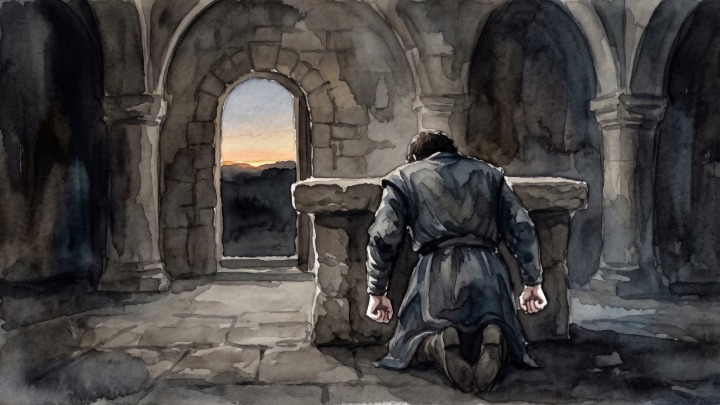
The church has never quite known what to do with angry prayer.
Heman prays it for eighteen verses without softening. He never qualifies the accusation with a polite acknowledgement that God must have his reasons. He brings the full weight of his fury to the altar, and the altar holds it.
"Why, LORD, do you reject me and hide your face from me?" (Psalm 88:14). "Your wrath has swept over me; your terrors have destroyed me" (Psalm 88:16). "You have taken from me friend and neighbor; darkness is my closest friend" (Psalm 88:18).
This is not a man who has made peace with his suffering. He is blaming God for it, very specifically. You did this. You rejected me. You hid your face. The psalm is not a complaint to the universe. It is a complaint to a particular Person, and in Heman's view that Person is responsible.
And the Holy Spirit preserved every word.
Most of us were raised to treat anger at God as a spiritual emergency. Something to confess quickly and repent of before continuing the prayer. The well-meaning verse on the wall says "Be still, and know that I am God" (Psalm 46:10), and we have read it as an instruction to suppress every part of us that is anything but still.
In the lament tradition, anger is not the opposite of faith. Apathy is.
The angry person is still on the line. The apathetic person has hung up.
Heman, in his rage, is doing what the placid believer often is not. He is still talking to God. He has not concluded that God is absent or that the prayer is pointless, and he has not gone quiet to manage his suffering alone. Eighteen verses deep, he is still holding the address. You. You. You.
The relationship is real enough to him that he is arguing inside it. The covenant runs deep enough that he appeals to it even while accusing God of breaking it. "LORD, you are the God who saves me; day and night I cry out to you" (Psalm 88:1). The opening verse names the relationship, and the next seventeen operate inside it. However furious, this is the prayer of a man who has not let go and will not.
Scripture is full of this. Job's whole book is it. "I cry out to you, God, but you do not answer; I stand up, but you merely look at me" (Job 30:20). When God finally speaks at the end, he does not rebuke Job for the anger. He rebukes the friends, the men who had been defending God's reputation by silencing Job's complaint. "You have not spoken the truth about me, as my servant Job has" (Job 42:7). The angry man had spoken rightly and the polite men had not, and the Lord said so himself.
Jeremiah went further and accused God of luring him in. "You deceived me, LORD, and I was deceived" (Jeremiah 20:7). The Hebrew verb is stronger than most English versions carry, close to enticing or seducing. The prophet of God told God, inside the canon of Scripture, that God had played him.
And on the cross, Jesus prayed the opening line of Psalm 22. "My God, my God, why have you forsaken me?" (Matthew 27:46). In the hour of his deepest faithfulness, the Son of God prayed a prayer that accuses God of abandonment.
You have a sentence you have been carrying, and you have been afraid to say it to God because you suspect it would offend him. You are probably wrong about the offence.
What Scripture warns against is not honest fury. It is the polished sentence you do not mean. The prayer that performs a peace your interior does not have. The thanksgiving offered through gritted teeth to a God you secretly suspect of cruelty. "These people come near to me with their mouth and honor me with their lips, but their hearts are far from me" (Isaiah 29:13). The far heart is the offence. The angry heart, still in the room and still calling him by name, is closer than the polite one.
So if you have been editing your prayers, showing God a sanitised version of your interior while the real one sits unspoken in your chest, Heman is permission. Pray the unedited version.
You can do it badly. The psalm is not a masterpiece in its emotional register. It is repetitive. It circles and says the same thing four times in different words. I am overwhelmed. I am rejected. You have done this. Why? Heman is not crafting a sermon. He is unloading, and you are allowed to unload too.
The prayer does not have to make theological sense by the end. Heman's does not. He never reconciles his accusation with his confession of God as Saviour. He leaves the contradiction in, sets it on the altar and walks away from it, and the contradiction is part of the prayer.
That is the deeper move of lament. Not resolving the contradiction between God's goodness and your suffering, but bringing the contradiction to the God it is about. You cannot finally work it out by yourself. You can only address it to him, in all its incoherence, and let him hold what your mind cannot.
The fury that stays in the room with God is closer to faith than the calm that has quietly walked out.
So bring the sentence. Without dressing it up, without resolving it, and knowing that the canon has long contained the prayer of a man who said darkness was his closest friend and was not struck down for saying it.
He was included. His prayer became Scripture. The Holy Spirit looked at the most furious version of his complaint and said yes, that is the prayer of my people, put it in.
He will do the same with yours.
Part 1: Darkness is my Closest Friend
Part 2: The Psalm that does not resolve